Free shipping on all orders · 90-day returns · Molded in Orange, California
The Bass Boat Cup Holder.com ← back to the bass boat page

The bass boat guides

How to get a drink onto the bow deck without drilling the gelcoat

No-drill ways to hold a drink on a bass boat casting deck - suction, clamps, adhesive, pedestal mounts, loose bases - and the numbers that decide each.

14 min read · 18 sources

How to get a drink onto the bow deck without drilling the gelcoat

You are standing on the trolling motor with a 40 oz in your off hand. The only drink holder on the boat is at the console, twenty feet behind you, and you are not walking back there every time you want a sip. So the tumbler goes on the carpet next to your boot, where it lives until a hookset or a wake finds it.

There are two ways out of that. One of them puts a hole in the boat. This is about the other one — what actually works on a bass boat when nothing is allowed to drill, clamp, or stay stuck to the gelcoat, and which of the no-drill answers survive contact with a front deck.

First, be honest about what the hole costs

Not because drilling is forbidden. Plenty of people do it, and done properly it is fine. But the reason this question gets asked at all is that a bass boat owner knows, correctly, that a hole in the deck of a fiberglass rig is not a five-minute job — and the cheap version of it is worse than doing nothing.

Your deck is almost certainly cored. Even boats with solid hulls generally have cored decks, cabins, stringers and bulkheads — plywood, balsa, foam or a composite board sandwiched between two thin fiberglass skins (Practical Sailor). That matters twice over. First, a self-tapping screw into cored glass has almost nothing to grab: "the only thing the threads have to bite into is the outer 'skin' of the fiberglass," which is why through-bolting is the preferred method every time (Boat Outfitters). Second, that screw is now a straw. Marine surveyor David Pascoe puts the mechanism bluntly: water moves through very small fissures and openings around a fastener by capillary action, and "the capillary effect has the ability to generate a flow of water far greater than the usual gravity effect" (Yacht Survey). His rule is that hardware "should always be bolted, and never screwed, even if it's not load bearing hardware." Wet core delaminates. Delaminated deck is the soft spot a buyer steps on three years from now.

Done right, the fix is not complicated, it is just work: overdrill a hole roughly twice the fastener diameter through the outer skin and core but not the inner skin, fill it with thickened epoxy, let it cure, then drill your real hole through the middle of that plug and through-bolt with a backing plate or large fender washers (Boat Outfitters). And it is not permanent maintenance-free: all marine sealants crack, shrink, break or deform over time, so bedded hardware wants pulling and re-bedding every three to five years.

Two more things specific to a bass boat front deck:

And know the size you would be committing to. The common flush marine holder wants a 3-inch cutout. Go up to a jumbo — the one sold specifically to take a big insulated tumbler — and the required cutout is 3-5/8 inches, in a 4-1/2-inch-deep can with a drain fitting (SeaLux). That is a hole saw through your bow deck, permanently, in one spot, for a holder the maker lists as fitting 30 oz Ramblers, travel mugs and bottles.

The diagnosis most people get wrong

The story everybody tells is that the big tumbler is too fat for the boat's holder. Check it against the actual numbers and the width story turns out to be real — and still not the thing that beats you.

Start with the drink. Stanley lists the 40 oz Quencher at roughly 3.5 x 5.4 x 11 inches, on a 3.1-inch base, and calls it car-cup-holder compatible (Stanley). YETI's straw-mug FAQ says its 25, 35 and 42 oz mugs want a cup holder at least three inches across (YETI).

Now the boat. The common flush marine holder is smaller than it looks: Sea-Dog's flush drink holder drops into a 3-inch cutout and takes containers up to 2-7/8 inches (Fisheries Supply), and Attwood's standard recessed holders use that same 3-inch hole. Bigger ones exist — Boat Outfitters lists a 4.25-inch-flange holder with a 3.5-inch interior, in a 3.64-inch cutout (Boat Outfitters) — and a 3.1-inch base drops into that one without argument.

So width is a real problem against a 2-7/8-inch opening and a solved problem against a 3.5-inch one. It is also the easiest of the three, because it is the only one a bigger hole fixes. The two that a bigger hole does not fix:

  1. Location. The bore is at the helm, because the helm is the one station on a bass boat where clear casting room was never the design requirement. The entire rest of the layout — 16 to 25 feet, low profile, maximized casting decks fore and aft, minimized seating, each deck laid out for one angler (Discover Boating) — exists to keep objects out of your way. A drink is an object.
  2. Proportion. Eleven inches of container standing on a three-inch base is a tall, narrow column. On the carpet, that column is holding itself up on a footprint the size of a coffee saucer, and it stays upright only as long as its center of mass stays inside that footprint. A hull roll, a wake, a step back — it doesn't take much lean before that boundary is crossed.

Which reframes the question. Even with a hole the right size, you still have a tall column at the wrong end of the boat. What you are actually after is a wider base under the drink than the drink came with, somewhere you can reach it.

The no-drill options, graded on a bass boat

Suction cups

Suction is the first thing everyone tries and the first thing the boat defeats.

The manufacturers are straight about it. E-Sea, which sells a suction-mounted marine cup holder, says plainly that "suction mounts only work very well on smooth clean surfaces," and that if the mounting area is not smooth — rough kayak plastic, non-skid, foam decking — you need one of their thin adhesive discs stuck down first before the cup will hold anything (E-Sea). Marine carpet is further outside that envelope than anything on their list. Suction needs a non-porous surface, and there is nothing to seal against here — it is pile.

Which leaves the gelcoat. Your hatch and rod locker lids are smooth, clean gelcoat, and suction genuinely works there. The trouble is that those lids are the flat real estate you open every fifteen minutes for rods and tackle, so the drink is now attached to a moving door. Load ratings do not help either: even suction that advertises it will mount to textured surfaces "whereas regular suction cups don't have a chance" publishes 8 pounds on smooth and 3 pounds on textured (FrogsFeet). Forty ounces of water alone is about 2.6 pounds, and a double-wall stainless tumbler is not weightless — call it three and a half to four pounds filled, sitting on the end of a lever arm, being rocked. Add a deck baking in July sun, and temperature change is exactly what the buying guides list as the thing that lets suction go (SnapIt). Suction is a solution with a shelf life.

Verdict: works on a hatch lid, does not work on carpet, and the lid is the wrong place.

Adhesive discs and VHB pads

The honest way to describe the adhesive route is that it fixes the suction problem by no longer being a no-drill solution in spirit. You have not made a hole, but you have made a permanent commitment to a spot on the gelcoat of a boat you probably still owe money on, and getting the pad back off a hull without leaving a ghost or lifting color is its own afternoon. If you were unwilling to drill because of resale, adhesive should give you the same pause for the same reason.

Verdict: a permanent decision wearing a temporary label.

Clamping to the seat pedestal

This is the best true no-drill mount on a bass boat, and the one most people never think of, because it ignores the deck entirely and grabs the post.

There are makers who build specifically for it — Cuda Customs sells bass boat cup holders that clamp around a seat pedestal with two stainless allen screws, rotate 360 degrees around the post, and require no holes (Cuda Customs). No drilling, no adhesive, and it puts the drink on the deck you are fishing.

Three things to know before you order one:

Verdict: the strongest no-drill mount available, if you have a post, keep the post in, and measure it first.

Rail clamps

Nothing to clamp to. Rail-mounted holders exist for pontoon fencing, center-console rod racks and sailboat pulpits. A bass boat bow has no rail by design — the entire point of the deck is that there is nothing on it. Buying guides list clamp-on mounts with the caveat that they require "a specific edge to mount," and can scratch if not padded (SnapIt), and that edge does not exist where you are standing.

Verdict: not applicable to this boat.

Rod holder inserts

A holder that drops into an existing flush rod tube is genuinely zero-install, and the standard caveat is that "location is fixed to existing rod holders" (SnapIt). On a bass boat that caveat is fatal: flush gunwale tubes are a saltwater center-console feature. The rods here live flat in a locker.

Verdict: great idea, wrong boat.

Using the holes that are already there

The one legitimate way to bolt something down without adding a penetration: mount to fasteners that already exist and are already bedded. The bow seat base has a factory hole pattern in the deck. So do trolling motor mounting plates and, on some rigs, factory accessory plates. A thin plate sandwiched under an existing base adds a mount without adding a leak path.

Two cautions and they are real. You are disturbing a bedded structural fitting, so it goes back with fresh sealant, not dry. And you are changing the load path on a fitting that holds a seated adult — if the base is already marginal, this is not where to find out.

Verdict: the right answer if you are handy, and a genuinely no-new-hole one.

Bases that just sit on the deck

Every buying guide in this category has a free-standing line item and dismisses it the same way: "can slide or tip over in rough seas, occupies surface space" (SnapIt). That caveat is fair and it stands. Nothing in this category is a mount, and a free-standing base is the one option with no mechanical connection to the boat at all.

What the one-line dismissal skips is that tipping is a geometry, and the geometry is the one variable you can change without touching the boat.

Base of support. A container goes over when its center of mass passes outside the footprint holding it up. On a three-inch base, that edge is about an inch and a half from the middle. Widen the footprint underneath it and the center of mass has to travel further horizontally before it clears the edge, which means it takes a bigger tilt — a harder roll, a bigger wake — to put it over. You have not changed the drink. You have changed how far the boat has to lean before the drink cares.

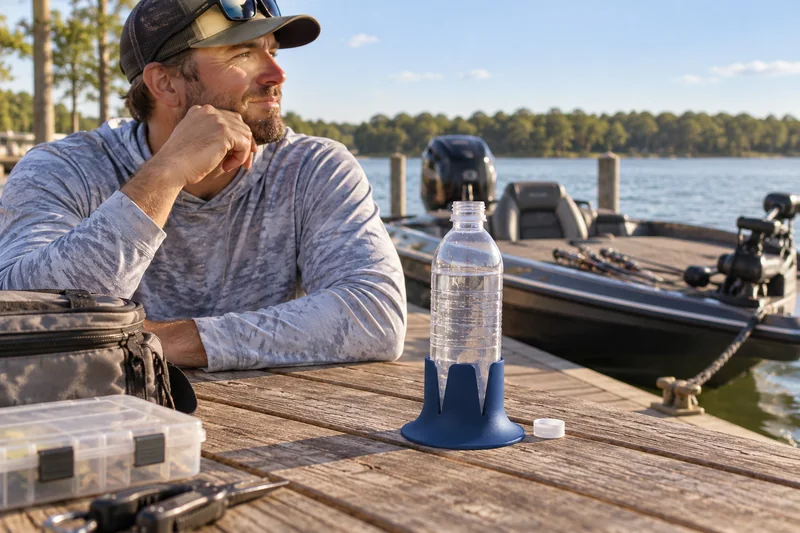
That is what Steadi is. One piece of Shore 85A TPU, 5.2 inches across the base and 2.8 inches tall, with fins that flex to grip the container's bottom inch. The 5.2-inch base is fixed — it does not expand, contract or deform. It resists tipping by widening the base of support, and the tack of the TPU resists sliding on a gelcoat lid. Nothing drills, nothing clamps, nothing sticks. It moves up the deck with you and goes in the locker for the run.

The limits, stated plainly, because this audience has been sold enough miracle gear:

Verdict: the category the guides write off, working the one variable — footprint — that you can actually change.

Where on the deck it actually goes

Whatever you end up with, placement decides whether you keep it.

The one thing no answer here solves

None of this survives the run. On plane, a bass boat is a highway vehicle — a 2025 Vexus VXs21 with a Mercury 250 Pro XS V-8 was tested at a 70 mph top end, on plane in just under five seconds (Boating). Nothing sitting loose on a deck belongs there when the hole shot comes, and nothing clamped to a seat post belongs there when the seat comes out. Every no-drill option on this page is a fishing-position solution, not a running solution. Drink it, stow it, or lose it — that decision gets made before you drop the hammer, not after.

Quick answers

Can you add a cup holder to a bass boat without drilling? Yes — three real routes: clamp to an existing seat pedestal, mount to fastener holes that already exist, or use a base that sits loose on the deck. Suction works on smooth gelcoat lids only, and adhesive is permanent in everything but name.

Will a suction cup holder stick to bass boat carpet? No. Suction needs a smooth, clean, non-porous surface; makers of marine suction holders say so themselves and sell adhesive discs as the workaround for rough surfaces.

Does a 40 oz tumbler fit a standard boat cup holder? Depends which holder. The 40 oz Quencher's base is 3.1 inches, and the common flush marine holder takes containers only up to 2-7/8 inches — so no, not that one. Larger holders with a 3.5-inch interior take it fine. And even where it fits, the bore is at the console and the drink is eleven inches tall.

What size hole does a marine cup holder need? A 3-inch cutout for the common flush holder, which accepts containers up to about 2-7/8 inches; roughly 3-5/8 inches for a jumbo tumbler holder, in a can about 4-1/2 inches deep.

What size is a bass boat seat pedestal post? The common marine size is 2-3/8 inches. Most general-purpose clamps stop short of that — RAM's largest Tough-Claw tops out at 2.2 inches — which is why bass-specific makers sell their own sizes and a universal option. Measure before you order.

Wondering about your specific cup? The fit database has sourced base measurements for 30+ containers — Stanley, Red Bull, Yeti, and the honest no's.

Sources

  1. Practical Sailor — Even boats with solid hulls generally have cored decks, cabins, stringers and bulkheads; coring may be plywood, balsa, foam or composite board.
  2. Boat Outfitters — In cored fiberglass a self-tapping screw only bites the outer skin; through-bolting is always preferred; overdrill roughly twice the fastener diameter through outer skin and core, backfill with thicke
  3. David Pascoe, Yacht Survey — Water enters deck penetrations by capillary action through very small fissures and openings, and 'the capillary effect has the ability to generate a flow of water far greater than the usual gravity ef
  4. Liquid Lumens — Technique for drilling gelcoat without chipping: tape the area, run the drill in reverse through the outer color layer, then switch to forward once into the glass.
  5. SeaLux — A jumbo marine drink holder requires a 3-5/8 inch cutout and is 4-1/2 inches deep including the drain fitting; the listing says it fits YETI 30 oz Rambler tumblers, travel mugs, beer bottles and more.
  6. Wholesale Marine — The Gen3 marine stainless cup holder is listed at 3.5 inch OUTER diameter with a 3.5 inch max depth. The page states no cutout or interior bore dimension - 3.5 in is not the opening.
  7. Stanley 1913 — Stanley lists the 40 oz Quencher at 3.54 x 5.43 x 11.02 inches with a 3.1 inch base diameter, and describes it as car cup holder compatible.
  8. Discover Boating — Bass boats run 16-25 feet with a low profile, maximized casting decks fore and aft each laid out for a single angler, minimized seating, and large livewells.
  9. E-Sea Company — Suction mounts only work very well on smooth clean surfaces; non-smooth mounting areas require a thin adhesive disc first; the holder is described as fitting slim cans up to large 30 oz tumblers.
  10. FrogsFeet — Boat suction cups that advertise mounting to textured surfaces 'whereas regular suction cups don't have a chance' are rated at 8 pounds on smooth surfaces and 3 pounds on textured surfaces; non-porous
  11. Cuda Customs — Clamp-on bass boat cup holders fasten around a seat pedestal with two stainless allen screws, rotate 360 degrees, require no drilling, and are sold in fixed 1-1/2 and 1-3/4 inch OD sizes plus a univer
  12. RAM Mounts — The RAM large Tough-Claw clamps 1 to 2.2 inch diameter rails and is rated 2 lbs standard use / 1 lb heavy-duty.
  13. Overton's — This Springfield boat seat pedestal is listed with a 2-3/8 inch post diameter.
  14. SnapIt Products — No-drill boat cup holder categories and their stated limits: clamp-on requires a specific edge; suction loses grip with temperature change or texture; free-standing can slide or tip in rough seas; rod
  15. Boating Magazine — A 2025 Vexus VXs21 with a Mercury 250 Pro XS tested at 70 mph top speed and got on plane in just under five seconds.
  16. YETI — YETI's straw-mug FAQ states that its 25, 35 and 42 oz mugs with straw lid fit a standard cup holder with a minimum diameter of 3 inches.
  17. Fisheries Supply — The Sea-Dog flush mount drink holder requires a 3 inch diameter cutout and accommodates drink containers up to 2-7/8 inches. Attwood's standard recessed drink holder (11788-1) also mounts in a 3 inch
  18. Boat Outfitters — A larger marine cup holder with a 4.25 inch flange has a 3.5 inch interior diameter, a 3.64 inch cutout and a 3.625 inch depth.
Get one — ships free

Buying happens at steadilabs.com — the company that molds it.