The bass boat file
A bass boat is built for casting room and speed, not for holding a drink still — every flat surface on board exists for a different job. Here's the physics behind why each one fails a drink differently, what anglers already try, and what actually keeps one upright on a casting deck that never sits still.
Bass boats run about 16 to 25 feet, built low to the water on purpose, with maximized casting decks fore and aft — each laid out for a single angler to work a rod free of obstructions — and minimized seating everywhere else. That's the design brief: every square foot of the front deck earns its place by staying clear.
A drink is exactly the kind of object that brief was written to exclude. There's no ledge, no molded recess, no flat non-skid pad anywhere the angler actually stands all day working a trolling motor. The one departure from that rule — a factory drink holder — lives at the console, because the helm is the one station where clear casting room was never the requirement.
That single design decision explains most of what goes wrong afterward: the bow gets fished, and the drink stays a boat-length behind, wedged wherever it can fit.
Where a factory holder does exist, it follows a marine-industry standard: roughly a 3.5-inch interior diameter and about 3.25 to 3.625 inches of depth, sized for the 20 to 32 oz drinkware common when most of these boats were designed. On plenty of older rigs — Ranger owners on Facebook trade retrofit tips for this — the bow shipped with no holder at all, and adding one after the fact means committing to a drilled hole in a hull that wasn't built for it.
Even a working console holder solves the wrong problem twice over. It sits at the helm, a boat-length from the casting deck where the day is actually fished, and the drinkware culture has moved past its bore: the 30 to 40 oz insulated tumblers anglers now carry for a full day of sun routinely have bases wider than 3.5 inches. Marine sizing guides quietly route that size class to jumbo or ring-mounted holders most boats were never fitted with.
Walk the rest of the boat and the pattern repeats — every flat spot exists for a reason that has nothing to do with holding a drink.
The carpeted casting deck is springy underfoot by design and absorbent for the same reason it's soft: it takes in whatever lands on it. Forum threads on getting spilled coffee back out of bass boat carpet are common enough to be their own genre, including one angler's account of a full cup going over on deck minutes before a tournament.
The storage and rod locker lids are the broadest flat real estate on board, smooth and gently crowned so rain and spray run off — meaning a wet bottle has nothing to grip either — and they get opened constantly for rods and tackle, so anything resting there has to move on someone else's schedule.
The gunwale cap is narrow, rounded, and wetted by spray on a hull built with deliberately low freeboard — a shape that sheds a can in a wake the same way it sheds water. The pedestal and butt seats are slick vinyl on posts that swivel freely, so there's no fixed flat spot to begin with; the seat moves the second anyone bumps it.
None of these are failures of the boat. They're doing their actual job — holding a drink was never one of the jobs assigned to them.
Tournament-class rigs are fast — a 250 hp Vexus VXS21 has been clocked at 70 mph, and the Nitro Z21 XL runs into the low 70s, with most bass boats cruising somewhere between 40 and 70. At that speed, anything loose on deck stops being a convenience and becomes a projectile. So before every run — the hole shot — everything gets stowed, drink included, into a rod locker or glove box, and turns up at noon, warm, under a rain jacket.
The day usually starts the same way. Tournament mornings run on a blast-off at first safe light, boats idling in numbered order waiting for legal shooting time. The gas-station coffee that seemed necessary at 4:30 has no assigned spot yet — chugged at the dock, wedged between the knees for the idle out, or left on the truck bumper, because there's nowhere for it to ride out the run to the first spot.
None of this is a new problem, and the marine aisle has answers for it — just not ones that hold up under a closer look.
Suction-cup holders ask for a clean, smooth, dry surface to seal against, by the manufacturers' own product guides — which rules out textured gelcoat, marine carpet, and a dusty deck in the same breath. Adhesive-backed versions carry their own warnings about losing grip after extended sun and marine exposure — a fair description of a bass boat's entire working life.
Flush-mount, drop-in holders ask for a commitment: a roughly 3.6-inch hole cut in the deck, or self-tapping screws into the hull — the budget install owner groups describe. The hole left behind is still bored to the same 3.5-inch standard that never took the bigger tumblers to begin with.
Clamp-on rail holders grip round stock — pontoon fencing, center-console rod holders, sailboat pulpits. A casting deck is deliberately railless, so there's nothing near the bow to clamp to.
Folding, flip-out holders show up on aluminum-boat forums mainly in threads about how they fail: thin plastic that cracks, folding arms that boat vibration and rough water work loose over a season.
And jumbo or ring-mount holders marketed for oversized tumblers solve the diameter problem the same way flush-mount holders do — another hole, another commitment on a hull most owners are visibly reluctant to drill.
Line the failures up and they share one shape: every fix on the market assumes a fixed point — a bore, a rail, a clamp jaw, a suction seal — on a boat that doesn't reliably offer one. The casting deck gives underfoot, the gelcoat is smooth and crowned, the gunwale is narrow and wet. None of that is a defect to engineer around; it's just what the deck is.
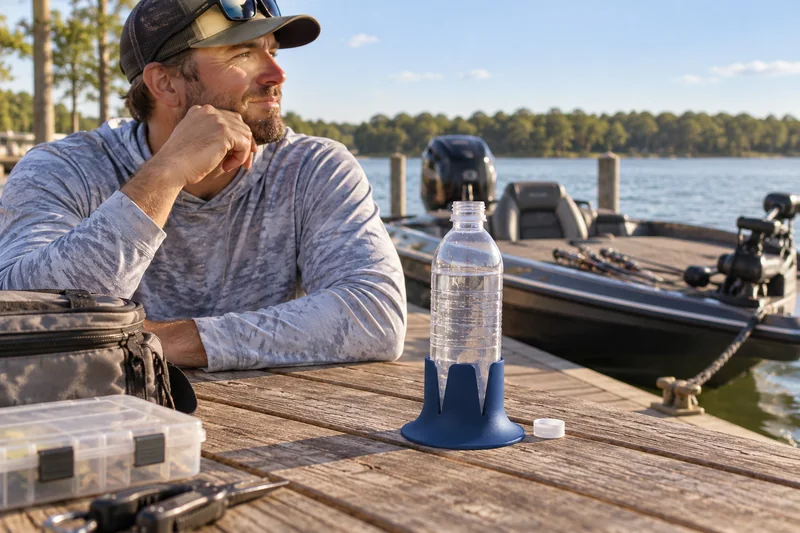
A base wide enough to spread its footprint across springy carpet or hard gelcoat alike, instead of narrowing to a bore sized to one drink's diameter, sidesteps the fixed-point problem. Flexible fins grip a container from the sides, low around its bottom inch, and do the holding instead of a rigid wall. When a wake rolls the hull or a hookset pulls your weight backward, a base like that flexes with the deck's own motion, resists tipping, and settles back in — rather than requiring the boat to hold still first, which a casting deck never does.
None of that needs a hole saw or a bore sized to someone else's tumbler — just a base built for a deck that was never going to hold still in the first place.
Get one — ships freeBuying happens at steadilabs.com — the company that molds it.